
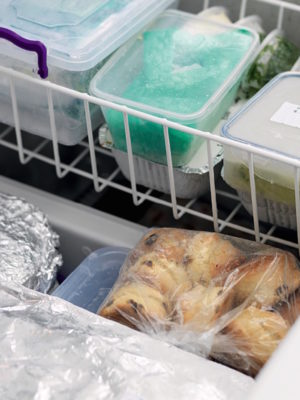
 We think that your freezer is your best friend in the kitchen, so Justine was very happy to help the Money Advice Service by coming up with a variety of tips to help people save time and money. These are the sort of tips Justine includes in her books and are really handy for anyone who is a bit of a freezer newbie or uses their freezer for nothing more than the odd pack of peas and pizza.
Solid and reliable, you can trust your freezer to take care of leftovers, bulk buys, impulse buys, batch-cooked dishes, near their use-by date foods and almost anything else that you don’t want to waste.
Although food will freeze almost indefinitely, deterioration will occur over time, so it is best to use most foods within 3-6 months. That doesn’t mean you should chuck out anything that’s been in there longer, but just try and get in the habit of using what you have regularly. A freezer night at least once a week is a useful way of using up your freezer contents rather than shopping for fresh food.
If you have a small freezer and need to save space, we recommend Justine’s method of flat-freezing your food in zip-seal bags – this technique works brilliantly for anything saucy, such as soups, stews, curries, bolognese, stocks, poached fruit and purees.
Wrap it well
Always wrap and label food really well. You need to keep out as much air as possible to protect the surface from icy patches and freezer burn and to prevent flavour transfer between foods or discolouration. I use thick freezer bags and reusable plastic tubs. Liquids expand when frozen, so leave a 2–3cm gap at the top of containers.
Waste-not, Want not
Perishable items, such as meat, poultry and ham, can be successfully and safely frozen up to their use-by date, so don’t leave them lurking at the back of the fridge for days once opened. Wrap tightly before freezing and thaw in the fridge.
Freeze your leftovers
Freeze leftovers rather than wasting them. Make up single portions of meals such as spaghetti Bolognese, or stew and freeze in reusable plastic containers for home-made ready meals. Even meat leftover from a roast joint can be sliced and made into sandwiches for freezing. Leftover vegetables can be made dishes like bubble and squeak or thick soups.
Ensure that any meals that have been frozen are thoroughly reheated until steaming hot before serving.
Buy one, put one in the freezer
Make the most of supermarket offers by freezing BOGOF items. Anything from meat, chicken, ham, bacon, cheese, butter, breads and pastries freeze well. Make sure you wrap tightly to expel as much air as possible.
Try frozen fruit instead of fresh
Frozen fruit represents great value for money and can be used for topping yogurt for breakfast, making into quick smoothies, pies and crumbles. Because you only take out what you need and it’s fully prepared for you, there’s no waste. The same applies to frozen vegetables, which have been shown to contain more vitamins than most fresh veg too.
Portion control
Catering size cans usually represent better value for money. Freeze the contents in handy portions and take out just what you need. Canned tomatoes, baked beans, soups and canned fruit can all be frozen. You can buy cheap, reusable plastic containers in pound shops and online, or flat-freeze in freezer bags and reheat from frozen.